What CVE-2026-84281 Discloses
CVE-2026-84281 is a stored cross-site scripting vulnerability in Fancy Product Designer for WordPress, affecting all versions up to and including 6.5.2. The flaw centers on the productTitle value the plugin stores in _fpd_data order item meta. The fpd_save_order AJAX action is registered for unauthenticated users through wp_ajax_nopriv_fpd_save_order with no nonce and no capability check, so anyone can submit order data. Only strip_tags() is applied at save time, and the disclosure shows that submitting JSON unicode escape sequences such as \u003c and \u003e defeats it: json_decode() silently converts them back into literal angle brackets when the order is rendered. Arbitrary web scripts then execute in the browser of any user who opens the injected page — the admin order view. Version 6.5.3 fixes the vulnerability.
BitFire FREE Bot Protection Stops the AJAX Delivery
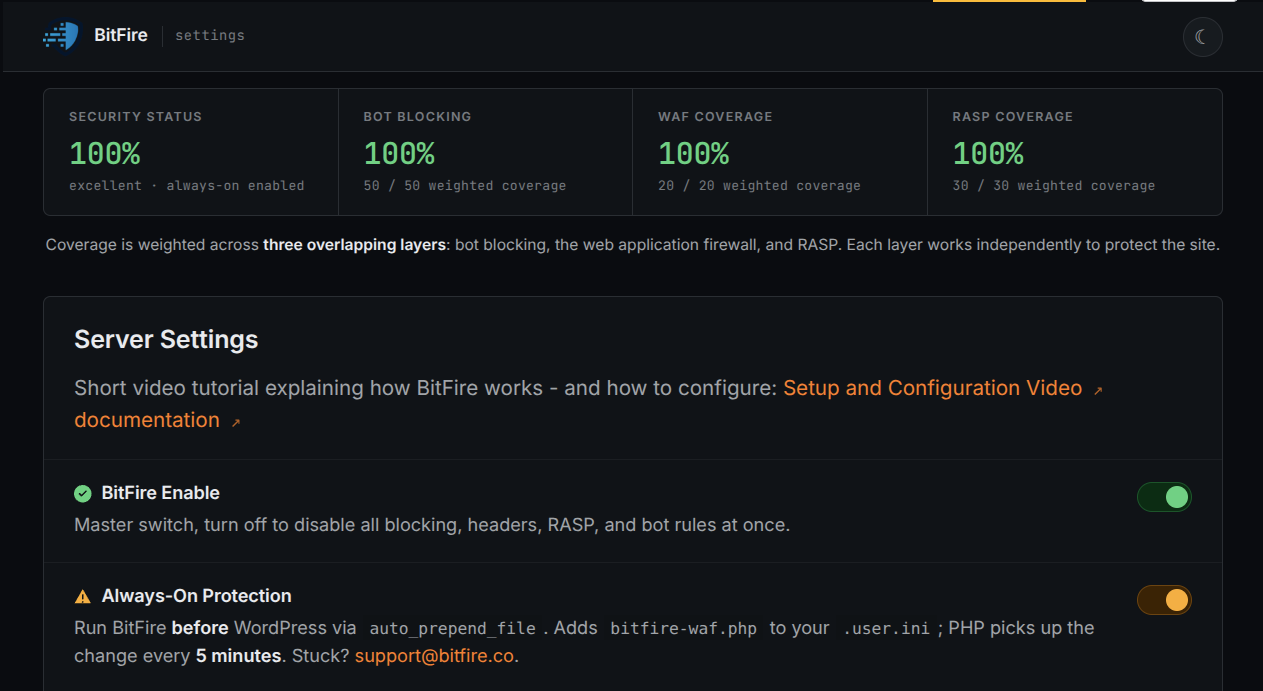
The exploit begins as an automated, unauthenticated AJAX submission to the fpd_save_order action — exactly the traffic BitFire FREE Bot Protection is built to stop. Unknown or restricted clients cannot submit forms, POST data, or call sensitive AJAX endpoints, and a client presenting as a browser must pass lightweight JavaScript verification that real browsers pass automatically and exploit scripts typically fail. The scripted delivery dies before WordPress ever loads the vulnerable handler. Trusted integrations that are explicitly allowlisted bypass bot restrictions only — never WAF enforcement. Best of all, these bot rules need no CVE-specific signature, because they classify the delivery step itself, not one particular payload.
BitFire FREE WAF Blocks the Script Payload
Bot classification is the first layer; payload inspection is the second. The BitFire FREE WAF evaluates what every request contains — URLs, query strings, form fields, POST bodies, and cookies — before WordPress or any plugin processes it. Its cross-site scripting detection targets precisely the malicious script injection that CVE-2026-84281 carries in the productTitle value, blocking matching script payloads before the plugin stores them in order item meta. Together, the two FREE layers cover both required steps of this exploit: the unauthenticated scripted delivery and the injected payload. Both controls ship in BitFire FREE for eligible non-commercial websites; commercial sites require the appropriate commercial license.
If Your Site Was Affected, Investigate for Persistence.
Update Fancy Product Designer to version 6.5.3 immediately — the vendor identifies 6.5.3 as the fixed release. But patching only closes the injection path; it does not scrub payloads attackers stored beforehand, and injected order data stays dangerous until it is found and removed. Review stored order records for unexpected script content and encoded fragments, delete any injected entries, and rotate relevant credentials. Then run BitFire Threat Hunter, which investigates for the hallmarks of an exploited site: backdoor WordPress administrator accounts, hidden database triggers, suspicious database content, long-running PHP processes, and droppers that can restore malware or reinfect the site. An absence of obvious malicious files is not proof a site is clean — investigate, remove every persistence mechanism found, and re-verify.
Deploy BitFire, Patch, and Verify You Are Clean
CVE-2026-84281 needs no account, no nonce, and no privilege — just one unauthenticated AJAX request that plants a script in front of your administrators. Deploy BitFire and stop it at the request layer: FREE Bot Protection blocks the scripted delivery, and the FREE WAF blocks the payload before vulnerable code stores it. Then update to 6.5.3 without delay. If an affected version ever ran on your site, run BitFire Threat Hunter to confirm no persistence remains. Install BitFire today and secure your storefront.